Add your promotional text...
VR Safety Training for Industrial Workers: Transforming Workplace Safety with Virtual Reality
Discover how VR Safety Training is revolutionizing industrial worker education through immersive, risk-free simulations. Learn how Virtual Reality, AI, and 360° technology improve workplace safety, reduce accidents, and enhance employee performance. Explore industrial VR training solutions by 360 VR Photography.
AUGEMENTED REALITY
Viral Gala
7/2/20266 min read
VR Safety Training for Industrial Workers: Revolutionizing Workplace Safety with Virtual Reality
Introduction: Moving Beyond the Clipboard and Slide Deck
Industrial workspaces—whether they are sprawling manufacturing plants, volatile oil and gas facilities, high-velocity logistics warehouses, or heavy construction sites—are inherently demanding environments. For decades, safety managers have relied on a traditional script to protect their workforces: classroom presentations, thick printed manuals, and click-through compliance screens.
Yet, there remains a massive problem with passive learning. Peer-reviewed studies on industrial behavior consistently show that workers forget up to 70% of traditional lecture content within just 72 hours. In a high-stakes, heavy industrial zone, forgetting a lock-out protocol or misjudging a forklift clearance isn't just an administrative error—it is an immediate operational liability.
This retention problem is precisely why Industry 4.0 is undergoing a structural shift toward Virtual Reality (VR) Safety Training.
By merging high-fidelity 360° simulations with Artificial Intelligence (AI), organizations can now place their teams inside realistic emergency scenarios where they learn by doing. Workers can safely practice handling critical operational hazards without ever being exposed to real-world physical danger.
At 360 VR Photography, we design these exact, high-impact immersive training environments to help heavy industries build a resilient, confident, and highly safety-compliant workforce.
What Exactly Is VR Safety Training?
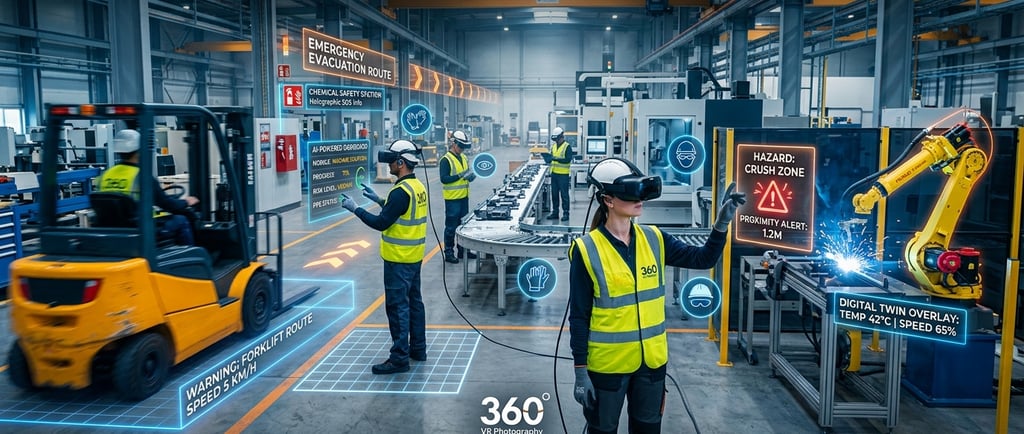
VR safety training places an operator or technician inside a photorealistic, 3D spatial simulation using a standalone headset. Instead of looking at a flat drawing of a hazard, the user experiences it at a true 1:1 scale with accurate depth perception.
According to comprehensive enterprise research compiled by PwC's Immersive Training Study, individuals trained via virtual reality complete their modules up to four times faster than classroom learners and are 275% more confident to correctly apply their new safety knowledge on the live production floor.
Inside a tailored industrial safety simulation, a trainee can:
Navigate and audit high-risk facility layouts to isolate hidden structural hazards.
Practice critical Lockout/Tagout (LOTO) energy isolation steps on complex machinery.
Respond actively to sudden simulations of chemical leaks, arc flashes, or electrical fires.
Master proper Personal Protective Equipment (PPE) inspection steps under active evaluation.
Safely navigate heavy equipment like forklifts and overhead cranes in high-traffic zones.
Why Leading Industries Are Leaving Lectures Behind
The core limitation of standard safety training is that you cannot safely simulate a crisis in the real world. You cannot intentionally trigger a toxic gas leak or a warehouse fire just to see how your floor team reacts under pressure. Traditional drills end up feeling like predictable walks down a hallway.
VR solves this paradox. It allows for controlled, high-consequence failure. If a trainee panics, skips a vital safety verification, or selects the wrong fire extinguisher class, the simulation displays the realistic, dangerous outcome visually. The worker experiences the deep psychological impact of the mistake with zero real-world injury, zero structural damage, and zero operational downtime.
Data from global industrial deployments shows that implementing immersive safety simulations correlates with a stunning 43% drop in real-world workplace accidents.
[Traditional Slide Training] ➔ 10% Long-Term Protocol Retention ➔ High Operational Accident Liability [AI-Powered Spatial VR] ➔ 75% Long-Term Protocol Retention ➔ 43% Reduction in Workplace Injuries
Five Core Business Advantages of Immersive Safety Labs
1. Unmatched Knowledge Retention
Because an enclosed VR headset occupies your entire visual and auditory field, background workplace distractions are completely cut out. Users are up to four times more focused than e-learners, driving safety protocol retention up to 75% over a one-year period.
2. Massive Long-Term Cost Savings
Traditional hands-on heavy equipment training requires taking expensive machinery out of production, wasting raw materials, and paying for dedicated on-site instructors. VR software is completely scalable; once your custom environment is built, it can be run thousands of times across global facilities with near-zero recurring setup costs.
3. Accelerated Employee Onboarding
New hires can master complex facility layouts, locate emergency exits, and learn machine safety protocols virtually weeks before they step onto a high-risk production floor. This shortens the corporate onboarding path by up to 60% while building deep employee confidence.
4. Standardized Global Compliance
Whether you are onboarding an engineer in Europe or a technician in Ahmedabad, every single worker moves through the exact same high-standard safety curriculum. This eliminates human training variables and ensures flawless alignment with international OSHA and local safety regulations.
5. AI-Driven Adaptive Performance Metrics
Modern simulations do not use fixed, predictive paths. Integrated AI layers actively track user response times, eye-gaze tracking, and operational choices. If the system flags that a worker excels at fire evacuation but struggles with chemical isolation steps, it automatically alters the scenario's difficulty to focus heavily on their distinct weak points, delivering a personalized learning curve.
The Power of Photorealism: Layering AI Over 360° Digital Twins
While abstract, cartoonish 3D models are useful for gaming, industrial operations demand total visual authenticity. Workers need to train inside the actual environments they will operate in, recognizing the real pipe configurations, the exact valve labels, and the genuine structural constraints of your specific plant. This is why our training frameworks are anchored on high-resolution 360° VR Photography.
By using advanced multi-lens camera systems like the Insta360 Pro 2, our engineering teams capture your physical facilities with absolute clarity. Once this photorealistic digital twin foundation is built, we layer the interactive AI logic, voice assistants, and floating metric dashboards over the top. This gives your teams a highly trusted training ground that perfectly mirrors their real-world environment.
Keeping Your Physical Credentials Secure and Embassy-Ready
As your company scales its digital authority with advanced immersive tech, smart professionals make sure their physical career and compliance portfolios are managed with equal care. If you are an engineer or safety manager preparing to relocate or consult abroad to run these advanced Industry 4.0 production lines, your original academic degrees and experience certificates must face strict consulate audits.
Global visa processing center scanners are highly sensitive to surface textures. If you laminate your certificates to protect them, the plastic layer creates intense light glare that blinds automated scanners, often leading to immediate visa delays or rejections.
At Spandan Lamination Remove Service, we use specialized thermodynamic technology to safely separate thick plastic lamination from original documents with zero paper tearing, zero ink smudging, and absolute preservation of official seals—ensuring your physical paperwork passes strict background checks smoothly.
Secure your original certificates: howtoremovelamination.com
Recommended Viewing
Before defining your company's mixed reality safety strategy, watch live visual overviews showing how automated hazard tracking operates inside modern industrial training spaces.
Search on YouTube: Look for "Industrial VR safety training forklift and LOTO simulations" or "PwC virtual reality enterprise training efficiency results" to watch real-world footage of how technical teams build muscle memory hands-free.
How 360 VR Photography Transforms Your Industrial Training
Integrating hands-free tracking data, animated callouts, and intelligent data interfaces into panoramic video requires an experienced creative partner who balances precision optics with deep spatial software development. At 360 VR Photography, we specialize in designing custom, end-to-end interactive spatial solutions that maximize engagement.
Our comprehensive service offerings include:
High-Resolution 360° Industrial Facility, Plant, and Warehouse Video Production
Advanced AI Motion Graphics, Spatial Typography, and Object Tracking Integration
Stunning 360° Aerial Drone Videography utilizing the elite Insta360 Pro 2
Extended Reality (XR), Augmented Reality (AR), and Mixed Reality (MR) Industrial Builds
Interactive Web Tours embedded with responsive technical data dashboards
360° Live Streaming and Metaverse Control Room Developments
Explore our digital assets: 360vrphotography.com | 360vrphotography.in
Frequently Asked Questions (FAQ)
Q1: Can an employee take a VR safety training module if they don't own a headset?
A: Yes, absolutely. While using a standalone headset like the Meta Quest 3 offers the absolute highest sensory immersion, all of our custom industrial training modules are built on flexible, cross-platform frameworks. Your workforce can access and interact with the 360-degree training perfectly using standard web browsers on their existing laptops, tablets, or smartphones.
Q2: How difficult is it to alter a VR safety scenario if our factory equipment changes?
A: It is completely seamless. Because the operational safety rules, data cards, and interactive triggers are hosted on an independent cloud software layer, updating text instructions, safety steps, or compliance questions requires a simple database modification without needing to physically reshoot your assets.
Q3: Can our company integrate the performance metrics from the VR training into our existing LMS?
A: Yes. Our immersive training architectures are engineered to easily sync with industry-standard Learning Management Systems (LMS) via secure SCORM or xAPI protocols, allowing your HR and safety directors to track employee progress, test scores, and response times right on your centralized internal dashboard.
Build a Zero-Harm Workplace: Partner with Us Today
Ready to eliminate archaic, unengaging safety lectures and position your organization at the absolute forefront of modern industrial performance? Let’s collaborate to build an unforgettable, AI-driven VR safety training asset tailored specifically to your plant operations.
Founder & Immersive Professional: Viral Gala
Direct Call / WhatsApp: +91 99203 22366
Official Corporate Email: info@360vrphotography.in
Immersive Portals: 360vrphotography.com | 360vrphotography.in
Document Preservation Hub: howtoremovelamination.com

Experience
Engaging virtual tours for real estate and events.
Innovative
info@360vrphotography.in
+91 9920322366