Add your promotional text...
VR in Product Design: Prototyping Made Easy with Virtual Reality
Explore how VR in product design simplifies prototyping, reduces costs, and accelerates innovation. Learn how virtual reality is transforming design workflows and product development.
Viral Gala
12/14/20253 min read
VR in Product Design: Prototyping Made Easy (From Concept to Reality)
In today’s fast-moving world of innovation, speed and accuracy in product design are the ultimate competitive advantage. Traditional prototyping—creating physical mockups—is often expensive, time-consuming, and limited by physical materials.
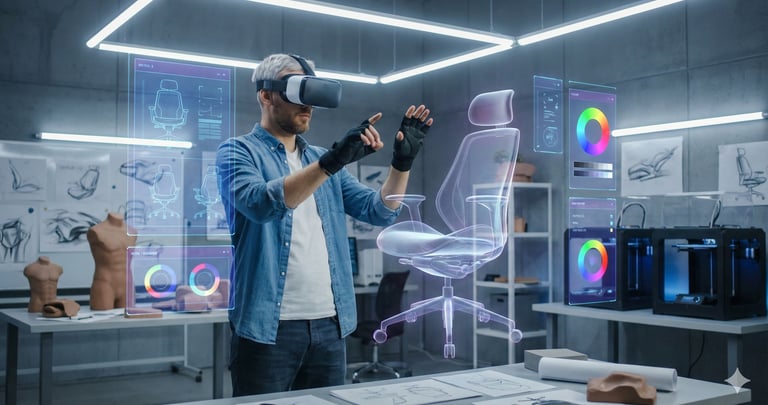
This is where Virtual Reality (VR) is fundamentally transforming product design, making the process faster, smarter, and infinitely more collaborative. Instead of just imagining how a product will look, you can literally step inside the design and interact with it at a 1:1 scale.
❤️ The Human Element: Feeling the Design
The most significant benefit of VR is restoring the human scale and perspective to design. Looking at a complex 3D model on a flat monitor can be deceptive. A small error in ergonomics or visibility on a screen can become a massive, costly flaw in a physical product.
With a VR headset, you are instantly immersed in the design. You can feel the difference between sitting in a virtual car cockpit designed by engineers in Stuttgart and one designed in Detroit. You can test the reachability of a medical instrument or the sightline of a machine operator. Design decisions become data-driven experiences, not assumptions.
How VR Makes Prototyping Easier
1. Rapid, Cost-Effective Virtual Prototyping
VR eliminates the need for expensive, material-intensive physical mockups early in the design phase.
Instant Iteration: Designers can change colors, materials, shapes, and textures instantly and compare multiple designs side-by-side—a process that takes weeks with physical models can be condensed into hours or even minutes.
Cost Reduction: Companies like Ford and Airbus leverage VR to significantly reduce costs associated with physical prototyping, saving potentially hundreds of thousands of dollars per product iteration (Source: Nasscom, Kompanions).
2. True 1:1 Scale Visualization
VR allows designers to view products at true 1:1 scale, which is critical for checking ergonomics and usability.
Automotive Design: Engineers can sit inside a virtual car to verify dashboard layouts, driver visibility, and component placement before a single physical part is manufactured.
Architecture & Furniture: Designers can literally walk through a virtual building or test if a piece of furniture fits correctly in a specific room's geometry.
3. Early Error Detection (Minimizing Risk)
Design flaws can be detected at the beginning, when they are cheapest to fix.
Assembly and Maintenance Validation: Engineers can simulate assembly processes and maintenance procedures in VR to identify spatial conflicts or design elements that would make repair difficult, ensuring the product is designed for maintenance (Source: Keysight Blogs).
4. Remote Collaboration in a Shared Space
VR is the ultimate tool for global design teams.
Teams across continents can meet inside the same virtual product simultaneously, reviewing designs and providing real-time feedback using virtual drawing tools. This eliminates the delay and cost of travel for crucial design review meetings.
Industry Case Study: Automotive Companies like BMW and KIA use VR headsets to conduct immersive design reviews. As one Kia Motors Europe executive noted, reviewing a car model with design management previously meant flying to Korea and took at least four days; now, it can be done in one hour using VR (Source: Varjo).
❓ Frequently Asked Questions (FAQ)
Q: What VR software is used for product design? A: Common professional tools include Autodesk VRED, Gravity Sketch, Unity, and Unreal Engine. These platforms allow for high-fidelity visualization and real-time modification.
Q: Can clients who are unfamiliar with VR participate in a design review? A: Yes. The immersive nature of VR makes complex technical designs instantly understandable to non-experts and clients, leading to faster approvals and reducing miscommunication.
Q: How does VR handle material textures and feel? A: While visual fidelity is high, haptic feedback is the next major step. Technologies are evolving to simulate the tactile sensations of touching and manipulating virtual objects, further bridging the gap between digital and physical prototypes.
🎥 Suggested Video: The VR Product Design Workflow
See how a designer uses VR tools to move a concept from a 2D sketch to a 3D immersive design:
YouTube Video Recommendation: "Design Concepts in VR - Virtual Reality Workflow"
🤝 Step Inside Your Next Innovation
If your brand or design firm needs to accelerate product development, reduce prototyping costs, and enhance global collaboration, 360 VR Photography offers the specialized immersive solutions you need.
We create custom:
Interactive VR Prototypes
Metaverse Product Showrooms
Mixed Reality (MR) Workflows for design review
We help brands visualize, test, and present products virtually—long before physical production begins.
Contact Viral Gala for an Immersive Design Consultation:
📞 +91 99203 22366

Experience
Engaging virtual tours for real estate and events.
Innovative
info@360vrphotography.in
+91 9920322366