Add your promotional text...

How Generative AI Creates Interactive VR Environments: The Future of Immersive Digital Experiences
Discover how Generative AI is transforming Virtual Reality by creating interactive VR environments automatically. Learn how AI-generated worlds, digital twins, and 360° VR photography are shaping the future of immersive experiences.
AUGEMENTED REALITY
Viral Gala
6/14/20265 min read

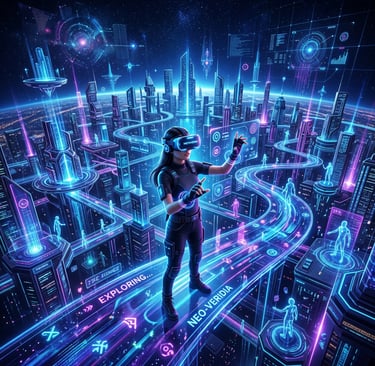
How Generative AI Creates Interactive VR Environments: The Birth of Intelligent Worlds
Introduction: The Dawn of the Intelligent Virtual World
The landscape of Virtual Reality (VR) is evolving at a breakneck pace. For years, the biggest bottleneck in immersive technology wasn’t the hardware—it was the grueling asset creation pipeline. Building a single, highly detailed virtual room, texturing every asset, and coding individual interactive scripts traditionally required months of labor from teams of 3D artists and software engineers.
Today, a massive paradigm shift is underway. The convergence of spatial computing and Generative Artificial Intelligence (AI) is completely transforming how digital environments are imagined, constructed, and experienced.
Whether you are navigating a virtual resort tour, stepping onto a digital twin real estate site, or running high-stakes industrial simulations, Generative AI allows developers to materialize complex, reactive 3D worlds in a fraction of the time.
By combining the structural flexibility of AI-generated content with the hyper-realistic accuracy of professional 360° VR Photography, organizations can now launch digital spaces that aren't just visually stunning—they are intelligent, adaptive, and highly personalized.
What Exactly Is Generative AI in Spatial Computing?
Generative AI refers to advanced machine learning models capable of synthesizing original, high-fidelity media based on simple human text prompts. While traditional computer graphics software relies on fixed math and manual modeling pipelines, generative engines analyze massive datasets of geometry, lighting, and textures to predict and build new assets from scratch.
According to technical documentation on Generative Artificial Intelligence on Wikipedia, these neural networks can instantly output original:
Volumetric 3D Meshes and Wireframes
Hyper-Realistic PBR (Physically Based Rendering) Textures
Dynamic Cinematic Audio and Voice Narrations
Intelligent, Autonomous Non-Player Characters (NPCs)
Instead of manually placing every virtual brick, a developer or creator can simply describe a vision: "Generate a high-end corporate showroom with brushed concrete textures, minimalist lighting, and an interactive glass display case." The AI immediately interprets the prompt, bringing the spatial geometry to life.
How Generative AI Actually Builds a VR Experience
1. Automated Procedural World-Building
Generative AI eliminates the tedious hours spent mapping out large environmental layouts. By using procedural generation rules, AI algorithms can instantly scale up expansive virtual landscapes, complex city blocks, historical exhibition halls, or comprehensive university campuses. This automation saves companies hundreds of production hours, allowing creators to focus entirely on fine-tuning the user experience.
2. Reactive, Intelligent Objects
In traditional VR setups, an object is either completely static or requires custom code to trigger a basic action. Generative AI makes the environment interactive. Virtual components can respond realistically to natural human touch, physics, or voice commands:
Interactive Museums: Artifacts can open up, display internal schematics, or visually reconstruct their historical timelines based on how a visitor holds them.
Smart Hospitality Showrooms: Virtual hotel rooms feature interactive controls where guests can change lighting schemes, view dynamic pricing, or alter interior layouts in real time.
3. Real-Time, AI-Driven Virtual Characters
The lonely, silent feeling of early virtual tours is completely gone. Modern interactive spaces feature intelligent virtual human guides or digital concierges. Because these avatars are backed by natural language processing, visitors can ask unscripted questions aloud—such as "Can you show me which executive suite has a sea-facing view?" or "What is the architectural history of this monument?"—and receive immediate, natural vocal responses and spatial direction.
[Legacy VR: Fixed Code] ➔ Static Environments ➔ Repetitive Scripted Guides ➔ Flat Interaction [Next-Gen AI VR: Spatial ML] ➔ Procedural 3D Worlds ➔ Conversational AI Avatars ➔ Truly Personalized Journeys
4. Deeply Personalized User Journeys
Generative AI acts as a live editor, analyzing user profiles and tracking behavioral movements inside a headset or browser to reshape the virtual world dynamically. For instance, a luxury resort tour can automatically highlight large family villas and child-friendly play zones for a family traveler, while seamlessly shifting to display corporate conference halls and high-end workspaces for a business executive.
The Crucial Intersection: Why 360° VR Photography is the Anchor
While fully artificial, AI-generated environments offer limitless imagination, they can sometimes lack the grounded authenticity and trusted precision that corporate clients and consumers demand. This is why the most successful spatial strategies do not rely on synthetic data alone—they bridge it with high-resolution 360° VR Photography.
By deploying top-tier panoramic capture setups like the Insta360 Pro 2, we can capture the absolute, unedited physical reality of your corporate offices, real estate projects, factory floors, or destination resorts. Generative AI is then used to augment this photorealistic foundation.
For example, a prospective buyer can stand inside a high-definition 360° view of an actual property, while an AI engine renders different furniture choices, swaps wall finishes instantly, or introduces an intelligent virtual guide to lead the walkthrough. This blend provides the absolute transparency of real-world imagery alongside the infinite flexibility of AI.
High-Impact Cross-Industry Applications
The practical integration of generative media and spatial twins is fueling rapid innovation across multiple business landscapes, a trend heavily discussed on professional tech communities like r/virtualreality on Reddit:
Hospitality & Tourism: Launching interactive virtual pre-tours that convert website browsers into direct room bookings.
Cultural Heritage & Museums: Teleporting global classrooms straight into immersive, historically accurate alternative realities populated by conversational historical figures.
Corporate & Technical Training: Simulating highly complex emergency procedures, factory floor safety scenarios, and product onboarding modules safely.
Recommended Viewing
To see how real-time generative software transforms text descriptions into fully navigable, rich 3D virtual spaces instantly, explore independent development showcases on YouTube.
Search on YouTube: Look for "Generative AI 360 world creation tools" or "Skybox AI blockade labs 3D generation" to watch live footage of creators building fully immersive environments through simple text inputs.
How 360 VR Photography Architects Your Spatial Strategy
Stepping into the future of intelligent, AI-powered marketing requires a highly specialized technical partner who understands both precision camera hardware and advanced interactive software design. At 360 VR Photography, we build the robust digital infrastructure that connects physical spaces with modern artificial intelligence.
Our comprehensive service offerings include:
High-Resolution 360° Industrial, Commercial, and Real Estate Captures
Seamless Conversational AI Avatar Integration for Virtual Showrooms
Stunning 360° Aerial Drone Panoramas for Sprawling Landscapes
Custom Virtual Reality (VR), Augmented Reality (AR), and Mixed Reality (MR) Builds
Interactive Virtual Tours embedded with responsive e-commerce checkouts
Advanced Digital Twin Creation using industry-standard systems like the Insta360 Pro 2
Frequently Asked Questions (FAQ)
Q1: Can a standard web browser handle an AI-powered 360° virtual tour?
A: Yes, absolutely. While our virtual environments deliver maximum sensory immersion through a standalone headset like the Meta Quest 3, they are coded on highly optimized, responsive web frameworks. Your global audience can explore your spaces and interact fluently with AI guides using standard browsers on their existing smartphones, tablets, or laptops.
Q2: How does integrating Generative AI cut down the cost of building a virtual showroom?
A: Traditionally, changing a product display, swapping floor layouts, or introducing new text guides required hiring a development team to manually re-model and re-program the tour. Generative AI allows these updates to happen seamlessly through automated, data-driven cloud inputs, radically lowering long-term maintenance costs.
Q3: How secure is company data when linking an AI guide to our internal factory or facility tour?
A: We treat security as a primary priority. The conversational AI models we deploy are isolated within secure enterprise cloud environments. This ensures your proprietary facility blueprints, operational telemetry, and internal customer interactions remain completely private and fully protected against external leaks.
Elevate Your Digital Strategy: Partner with Us Today
Ready to move your brand past simple static presentations and lead your market with an intelligent, highly engaging, and responsive spatial twin asset? Let’s collaborate to build an unforgettable 360° virtual experience for your audience.
Founder: Viral Gala
Company Name: 360 VR Photography
Contact Number: +91 9920322366
Websites: 360vrphotography.com | 360vrphotography.in

Experience
Engaging virtual tours for real estate and events.
Innovative
info@360vrphotography.in
+91 9920322366