Add your promotional text...

How AI Improves User Engagement in VR Experiences | The Future of Immersive Virtual Reality
Discover how Artificial Intelligence is transforming Virtual Reality by creating personalized, interactive, and intelligent VR experiences. Learn how AI-powered VR increases user engagement across education, training, real estate, tourism, healthcare, and business.
METAVERSE
Viral Gala
7/5/20266 min read
How AI Improves User Engagement in VR Experiences | The Future of Immersive Interaction
Introduction: From Passive Observation to Active Agency
Virtual Reality (VR) has fundamentally changed how we explore digital worlds. We put on a headset and instantly teleport onto a sun-drenched resort balcony, an expansive factory floor, or a pristine real estate development. Yet, as the novelty of simple 3D viewing evolves, users want more than just stunning static graphics—they want meaningful interaction, real-time personalization, and intelligent responses.
This is where Artificial Intelligence (AI) is completely transforming spatial computing.
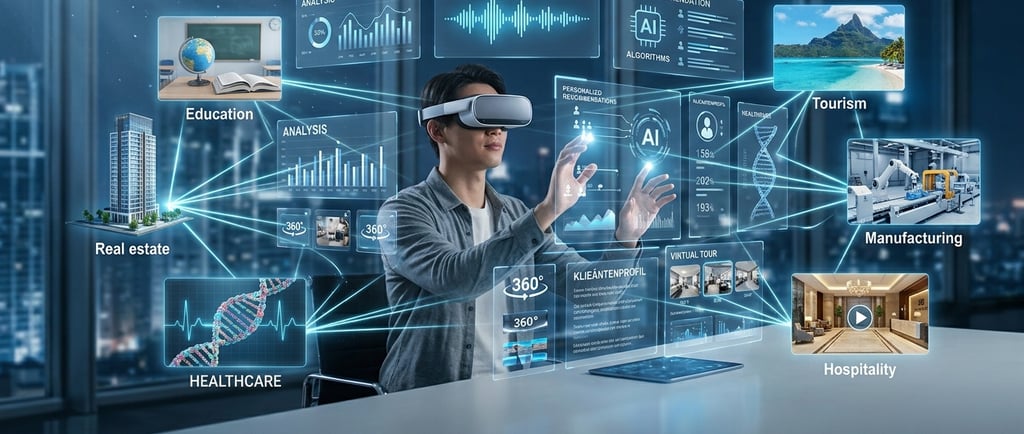
By fusing AI with VR, businesses are breaking out of rigid, pre-programmed code loops to build dynamic, responsive digital ecosystems that adapt to individual users in real time. According to recent technical insights on Virtual Reality trends, AI integration is expanding dramatically to generate procedural environments and intelligent behaviors that make virtual worlds evolve organically based on user action.
Whether it's an interactive virtual showroom, a corporate training module, or a cultural heritage tour, AI is shifting the user role from a passive spectator to an active participant. At 360 VR Photography, we integrate these advanced AI layers into hyper-realistic environments to maximize user engagement and drive measurable business results.
Why User Engagement Rules the Immersive Web
The ultimate success of an immersive campaign depends heavily on the psychological concept of presence—the feeling that you are genuinely existing inside the digital space. When an environment feels alive and interactive, user behavior shifts dramatically.
According to data on the immersive industry shared on r/virtualreality on Reddit, spatial campaigns generate significantly higher memory recall and deeper attention spans compared to traditional mobile media.
[Traditional Video Call/2D Media] ➔ Passive Window View ➔ High Distraction Rates ➔ Minimal Recall [AI-Enhanced Spatial VR] ➔ Active 3D Dialogue ➔ 100% Locked Attention ➔ 4x Retention Acceleration
Skyrocketing Dwell Time: Website visitors linger twice as long when exploring responsive, adaptive environments.
Deeper Data Retention: Interactive, multi-sensory experiences help professionals and students recall technical information much faster than reading static slides.
Minimized Buyer Friction: Providing absolute transparency and answering buyer questions instantly accelerates purchasing timelines and drives higher direct conversions.
Seven Core Ways AI Makes Virtual Environments Smarter
1. Tailored Personalization Engines
No two users approach a virtual tour with the exact same intent. An enterprise executive exploring a resort wants a deep look at conference amenities and connectivity, while a vacationing family wants to view sprawling villas and children's play areas. AI personalization engines analyze real-time user behavior, automatically adjusting the layout, navigation nodes, and highlighted content paths to deliver a customized journey for every single visitor.
2. Conversational AI Narrators and Guides
The silent, lonely feeling of early virtual walkthroughs has officially disappeared. Modern immersive spaces feature conversational virtual guides powered by advanced speech processing. These digital hosts don't just read a dry, recorded script; they welcome visitors by name, share nuanced brand stories, and provide helpful, context-aware information 24 hours a day, 7 days a week.
3. Hands-Free Voice Navigation
Fumbling with clunky plastic controllers while blinded by a headset is one of VR's biggest adoption hurdles. Voice-controlled computing completely eliminates this friction. Users can smoothly navigate an entire 360-degree environment simply by speaking naturally ("Show me the executive suite" or "Go to the engine room").
4. Adaptive Learning and Technical Training Labs
In industrial, manufacturing, and healthcare training, AI acts as an active, always-on coach. As a worker practices high-stakes operational workflows or assembly steps inside a safe virtual simulation, the AI monitors performance, detects structural errors, automatically calibrates the difficulty level, and delivers personalized corrective feedback to accelerate muscle memory.
5. Realistic AI Avatars and Digital Ambassadors
According to industry benchmarks for Avatars on Wikipedia, autonomous digital personas have shifted from rigid animations into highly expressive entities. Backed by generative machine learning, modern AI avatars incorporate natural fluid body language, micro-facial expressions, and emotional vocal synthesis, making interactions with virtual characters feel remarkably human.
6. Gaze-Aware and Smart Object Recognition
Advanced spatial tracking hardware allows AI algorithms to analyze look patterns and eye-gaze duration. If the software flags that a user’s line of sight is lingering curiously on an intricate valve or a piece of artwork, it instantly identifies the object and smoothly fades in contextual specification overlays, pricing details, or deeper audio narratives without requiring a manual click.
7. Real-Time Language Translation
AI enables seamless multilingual communication during spatial experiences. Visitors from different countries can explore the exact same virtual tour in their preferred language natively—whether it's English, Hindi, Gujarati, German, or Japanese—making businesses completely accessible to global audiences.
The Anchor: Pairing Smart AI Overlays with 360° Digital Twins
While purely synthetic, computer-generated 3D gaming spaces offer immense design freedom, modern consumers and B2B buyers demand unedited physical authenticity before signing contracts or booking luxury suites. They want to see your actual facilities, your real rooms, and your genuine property layouts. This is why the highest-converting digital strategies anchor their artificial intelligence over high-resolution 360° VR Photography.
By deploying premier, multi-lens hardware arrays like the Insta360 Pro 2, our production teams map out the photorealistic reality of your business down to the finest line. Layering an intelligent conversational voice engine or gaze-activated object recognition over these hyper-realistic 360° digital twins delivers the perfect blend: the trusted transparency of real photography matched with the effortless, hands-free navigation of modern artificial intelligence.
Protecting Your Physical Portfolio in a Digital-First Era
As modern brands aggressively deploy high-tech digital twins to dominate global search rankings, smart professionals ensure their physical background credentials match their digital authority. If you are preparing to work, expand your corporate footprint, or study abroad to manage these advanced mixed reality campaigns, your original academic degrees and employment letters will face strict consulate verification checks.
Immigration pipelines use highly sensitive automated document scanners to check paper features like watermarks and embossed signatures. If you laminate your certificates to "protect" them, the reflective plastic pouch creates intense scanning glare and whiteouts, frequently causing immediate administrative rejections.
At Spandan Lamination Remove Service, we use highly calibrated thermodynamic technology to safely separate thick plastic lamination from original papers without any structural tearing, paper splitting, or ink bleeding—keeping your physical paperwork just as flawless as your immersive digital assets.
Protect your physical certificates: howtoremovelamination.com
Recommended Viewing
Before planning your next multi-platform immersive marketing asset, explore live corporate showcases breaking down how conversational intelligence and real-time computer vision combine inside spatial environments.
Search on YouTube: Look up "AI digital twins and spatial computing user engagement trends" or "Interactive VR showrooms powered by conversational AI" to see firsthand how smoothly automated avatars and context cards track user gaze inputs without any system lag.
How 360 VR Photography Architects Your Spatial Content
Integrating real-time speech processing, gaze-activated callouts, and personalized user pathways into panoramic media requires an experienced creative partner who balances precision optics with deep software development. At 360 VR Photography, we specialize in designing custom, end-to-end interactive spatial solutions that maximize engagement.
Our comprehensive service offerings include:
High-Resolution 360° Corporate, Resort, and Industrial Facility Captures
Advanced AI Voice Narration, Multilingual Overlays, and Speech Tracking Integration
Stunning 360° Aerial Drone Videography utilizing the elite Insta360 Pro 2
Extended Reality (XR), Augmented Reality (AR), and Mixed Reality (MR) Builds
Interactive Web Tours embedded with responsive e-commerce checkouts
360° Live Streaming and Metaverse Brand Activation Developments
Explore our digital assets: 360vrphotography.com | 360vrphotography.in
Frequently Asked Questions (FAQ)
Q1: Can a standard mobile phone browser support an AI-powered 360° virtual tour?
A: Yes, absolutely. While our spatial solutions deliver maximum sensory immersion through standalone hardware like the Meta Quest 3, they are fully built on highly optimized, web-native frameworks. Your target audience can use the microphone or touch screen on their standard mobile phone, tablet, or laptop to talk to the guide directly inside a basic web browser.
Q2: How does the AI guide get updated when our pricing, features, or exhibits change?
A: It is completely seamless. Because the guide's conversational brain is linked directly to a secure cloud database, updating your room rates, exhibition notes, event packages, or seasonal promotions requires a simple text database modification. You never have to reshoot your physical 360° visual assets.
Q3: How does integrating AI object recognition lower the long-term maintenance costs of a VR tour?
A: Traditionally, changing a product display or adding a new information box meant hiring a development team to manually re-model and re-program the tour. AI computer vision allows these asset changes to happen dynamically via cloud updates, instantly mapping updated context data cards over your existing real-world 360° backdrops without needing complex structural recoding.
Command Your Market Space: Partner with Us Today
Ready to eliminate flat, boring media presentations and lead your industry with an immersive, self-explanatory digital twin experience that educates buyers and drives conversions? Let’s collaborate to build an unforgettable, AI-enhanced 360° virtual experience tailored specifically to your brand objectives.
Founder & Immersive Professional: Viral Gala
Direct Call / WhatsApp: +91 99203 22366
Official Corporate Email: info@360vrphotography.in
Immersive Portals: 360vrphotography.com | 360vrphotography.in
Document Preservation Hub: howtoremovelamination.com

Experience
Engaging virtual tours for real estate and events.
Innovative
info@360vrphotography.in
+91 9920322366