Add your promotional text...

AR in Healthcare Applications | Future of Augmented Reality in Medical Industry
Discover how Augmented Reality (AR) is revolutionizing healthcare through medical training, surgery assistance, patient education, remote healthcare, and immersive medical visualization. Learn how AR solutions by 360 VR Photography are shaping the future of healthcare technology.
AUGEMENTED REALITY
Viral Gala
5/17/20266 min read
Introduction: The Future of Healthcare is Augmented
Technology is rapidly reshaping the healthcare industry, and one of the most exciting innovations leading this transformation is Augmented Reality (AR).
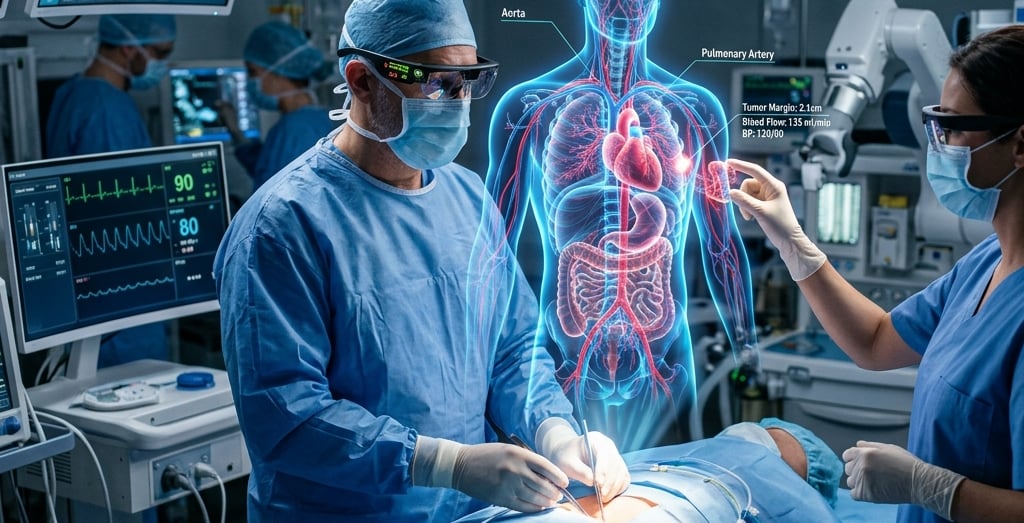
Imagine a surgeon viewing live 3D anatomy overlays during a critical procedure, medical students practicing complex surgeries in risk-free immersive simulations, or patients finally understanding their treatment through interactive visuals rather than confusing jargon. This is no longer science fiction—it is happening today in modern clinics and hospitals worldwide.
Unlike Virtual Reality (VR) on Wikipedia, which cuts you off from reality to create a fully digital environment, Augmented Reality enhances the real world. It overlays digital data, 3D models, and interactive elements directly onto our physical surroundings using smartphones, tablets, smart glasses, or advanced head-mounted displays. In medicine, this subtle blend of digital intelligence and physical reality is improving precision, education, and patient outcomes like never before.
What Exactly is Augmented Reality in Healthcare?
At its core, AR in healthcare bridges the gap between complex digital medical data and the physical environment where care happens. By overlaying real-time information onto a doctor's actual field of view, it acts as a powerful cognitive aid.
Healthcare professionals are currently utilizing AR to:
Visualize organs in high-definition 3D before making an incision.
Assist surgical teams with real-time digital guidance.
Improve diagnostic accuracy by aligning scans directly onto the patient's body.
Train medical students through hands-on, interactive simulations.
Guide rehabilitation exercises with immediate, visual feedback.
Educate patients interactively so they feel confident in their care.
This fusion of data and reality is actively building a safer, smarter, and far more efficient healthcare ecosystem.
1. AR-Assisted Surgeries: The Ultimate Intraoperative Guide
One of the most profound shifts driven by AR is happening right inside the operating theater. Traditionally, a surgeon must glance away from the patient to look at a separate monitor to check vital signs, CT scans, or endoscopic feeds.
AR technology changes this entirely by projecting critical information directly onto the patient's body. Surgeons can view:
3D anatomical overlays of internal structures.
The exact pathways of hidden blood vessels.
Precise tumor positioning and depth.
Real-time patient vitals.
This drastically improves surgical precision, procedure speed, and overall patient safety. By keeping the surgeon's eyes exactly where they need to be, AR reduces cognitive fatigue and minimizes the margin for error during complex, high-stakes operations.
2. Rewriting Medical Training & Education
For centuries, medical education has relied heavily on textbooks, flat diagrams, and cadaver dissection. While foundational, these methods lack the dynamic flexibility of living pathology.
AR transforms medical learning into a living, interactive experience. Students can:
Explore human anatomy in layered, 3D digital models.
Simulate surgeries safely where mistakes become valuable learning points rather than life-threatening errors.
Practice procedures repeatedly until muscle memory is perfected.
Instead of trying to translate a 2D drawing from a textbook into a 3D mental image, students can walk around, scale, and look inside life-sized digital organs. Medical communities on platforms like r/medicine on Reddit frequently discuss how these practical, immersive tools drastically improve knowledge retention and confidence among residents.
At 360 VR Photography, we specialize in designing customized, highly immersive AR and VR educational experiences that help medical institutions and universities modernize their healthcare training curriculums.
3. Turning Patient Education into a Visual Conversation
Medical explanations can easily overwhelm patients. When a doctor talks about "arterial occlusion" or "degenerative disc disease," it often leads to anxiety and confusion.
AR bridges this communication gap by turning a clinical lecture into an interactive, visual story. Using a tablet or AR glasses, a doctor can show a patient:
Exactly how a disease is progressing inside a 3D model of their own organ.
How a proposed surgical procedure will be performed step-by-step.
The exact way a specific medication interacts with their body to promote healing.
When patients can clearly visualize their diagnosis and treatment, their pre-surgery anxiety drops significantly, and their compliance with post-operative care dramatically improves.
4. Expanding the Reach of Remote Healthcare & Telemedicine
Geography should never dictate the quality of medical care a person receives. AR is breaking down physical barriers by supercharging telemedicine and remote clinical assistance.
Through AR-enabled smart glasses, a specialist sitting thousands of miles away can see exactly what a local nurse or field doctor sees. The specialist can overlay digital pointers, draw annotations on the field of view, and provide step-by-step instructions in real-time. This is proving life-saving for:
Remote surgical guidance in underserved rural areas.
Emergency medical support during transit or in disaster zones.
Live clinical consultations where specialized expertise is required instantly.
5. Gamifying Rehabilitation & Physical Therapy
Recovering from an injury or neurological event requires repetitive, often grueling physical therapy. It is incredibly easy for patients to lose motivation and drop out of their routines.
AR injects engagement and fun into the rehabilitation process by gamifying recovery. Patients looking through an AR device can follow interactive movement guides, play physical games designed to restore motor skills, and see their progress tracked visually in real time. This immediate feedback loop keeps patients deeply engaged, ensuring they complete their therapy regimens consistently and safely.
6. Seamless Hospital Navigation for Patients and Staff
Large, sprawling medical centers can feel like mazes, causing unnecessary stress for patients who are already anxious about an appointment.
AR-powered indoor navigation systems solve this by overlaying clear, digital walking paths onto the real world via a smartphone camera. Users can seamlessly find specific departments, emergency rooms, diagnostic laboratories, and inpatient wards without getting lost, significantly improving operational efficiency and reducing missed or late appointments.
7. Transforming Scans into Interactive 3D Visualizations
Reading traditional, flat gray slices of a CT or MRI scan requires years of specialized training, and even then, mentally assembling those slices into a 3D structure is challenging.
AR allows radiologists and clinicians to convert flat data into interactive, stereoscopic 3D models. Doctors can rotate, slice into, and scale up complex bone structures or vascular networks. This unparalleled visualization capability vastly improves initial diagnostic accuracy and allows for meticulous pre-surgical planning.
How 360 VR Photography Supports Healthcare Innovation
Embracing cutting-edge immersive tech can feel daunting. That is where we come in. At 360 VR Photography, we partner with healthcare organizations, medical colleges, pharmaceutical companies, and hospitals to design and execute next-generation digital solutions.
Our specialized immersive services include:
Custom Augmented Reality (AR) Experiences for patient and provider engagement.
Virtual Reality (VR) Medical Simulations for risk-free surgical and clinical training.
Mixed Reality (MR) Solutions fusing physical environments with interactive digital data.
Interactive Healthcare Demonstrations to showcase medical devices and complex mechanisms.
360° Hospital Virtual Tours to familiarize patients with facilities and reduce pre-admission stress.
AI-Powered Immersive Presentations & Metaverse Healthcare Experiences.
We turn complex medical data into intuitive, highly engaging digital experiences that simplify learning and elevate care.
The Pros and Cons of AR in Healthcare
While the benefits are monumental, widespread adoption requires balancing its immense value against current technical realities:
The Major Benefits:
Unrivaled Precision: 3D spatial awareness improves surgical accuracy.
Accelerated Learning: Immersive training yields higher retention rates than static media.
Empowered Patients: Visual clarity removes fear and builds clinical trust.
Rapid Decision Making: Immediate access to real-time data directly in the line of sight saves time when seconds count.
The Current Challenges:
High initial development and hardware implementation costs.
Hardware limitations, such as battery life and the weight of wearable headsets.
Stringent medical data privacy and compliance regulations.
The learning curve required for staff to seamlessly adopt new systems.
As spatial computing hardware becomes lighter and more affordable, these technological hurdles are rapidly disappearing, paving the way for mainstream global adoption.
Recommended Viewing
To see these incredible concepts in action, we highly recommend checking out this insightful video on YouTube:
Search for: "How Augmented Reality is Changing Medicine" or " HoloLens in the Operating Room" to watch real-world footage of surgeons and educators utilizing mixed reality overlays during complex medical procedures.
Final Thoughts: An Immersive Era of Care
The future of medicine is inherently collaborative, intelligent, and interactive. Augmented Reality isn’t here to replace the human touch of a doctor or the seasoned instinct of a surgeon—it is here to empower them with better data, clearer visualization, and smarter tools. From the lecture hall to the operating room, AR is proving to be an indispensable ally in modern medicine.
Frequently Asked Questions (FAQ)
Q1: What is the main difference between AR and VR in healthcare? A: Virtual Reality (VR) completely replaces the user's physical environment with a fully simulated digital world, making it ideal for deep-dive training or psychological therapy. Augmented Reality (AR) keeps the user anchored in the real world but overlays digital information, 3D models, or text onto their actual surroundings.
Q2: Is AR currently safe to use in active surgeries? A: Yes. FDA-cleared AR surgical guidance systems are actively used around the world, particularly in orthopedic, spinal, and neurosurgery, where sub-millimeter precision is required. It acts as an advanced GPS for the surgeon.
Q3: Can AR help patients who are undergoing physical therapy at home? A: Absolutely. AR applications can run on standard smartphones or tablets, allowing patients to see digital exercise guides projected into their living room while the app tracks their movements to ensure they are maintaining proper form.
Let’s Connect and Build the Future of Medicine Together
Ready to introduce immersive AR experiences, virtual simulations, or advanced 360° visual assets into your healthcare institution, medical device company, or training center? Get in touch with us today.
Founder: Viral Gala
Company Name: 360 VR Photography
Contact Number: +91 9920322366
Websites: 360vrphotography.com | 360vrphotography.in

Experience
Engaging virtual tours for real estate and events.
Innovative
info@360vrphotography.in
+91 9920322366