Add your promotional text...

AI-Based Object Recognition Inside VR Experiences: Making Virtual Worlds Smarter and More Interactive
Explore how AI-based object recognition enhances virtual reality by identifying people, products, and environments in real time. Learn how 360 VR Photography leverages immersive technology to create intelligent and engaging VR experiences.
THE FUTURE OF VIRTUAL REALITY
Viral Gala
6/19/20262 min read
AI-Based Object Recognition Inside VR Experiences: Making Virtual Worlds Smarter and More Interactive
Explore how AI-based object recognition enhances virtual reality by identifying people, products, and environments in real time. Learn how 360 VR Photography leverages immersive technology to create intelligent and engaging VR experiences.
AI-Based Object Recognition Inside VR Experiences
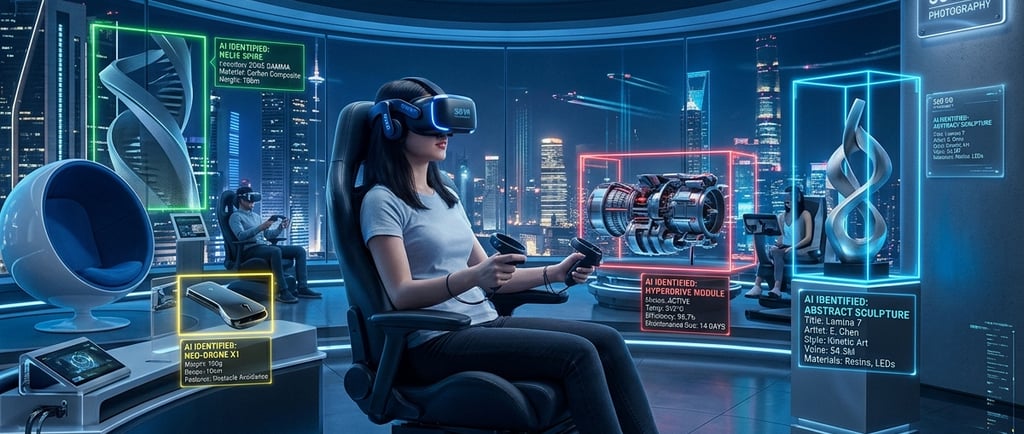
Virtual Reality (VR) has evolved from a visual storytelling medium into an intelligent, interactive platform. One of the most exciting developments is AI-based object recognition, which enables VR systems to identify and understand objects within immersive environments. By combining artificial intelligence with 360° content and virtual spaces, businesses can create experiences that are more dynamic, educational, and user-friendly.
Whether it’s a virtual factory tour, an interactive museum, or a product showcase, AI-powered object recognition helps users receive contextual information simply by looking at or selecting an object.
What Is AI-Based Object Recognition in VR?
AI-based object recognition uses computer vision and machine learning algorithms to detect and classify items such as machinery, furniture, artwork, retail products, or architectural features. When integrated into VR, the system can recognize these objects and present relevant information, animations, or interactive options.
For example:
In a virtual showroom, focusing on a product can reveal specifications and pricing.
During industrial training, looking at a machine can display safety instructions and operating procedures.
In an educational simulation, students can identify plants, tools, or historical artifacts and instantly access detailed explanations.
Key Benefits
1. Interactive Learning
Users receive instant information about recognized objects, making training and education more engaging and memorable.
2. Enhanced Product Demonstrations
Businesses can create immersive catalogs where customers explore products in 360° and access details through AI-driven recognition.
3. Smarter Virtual Tours
Tourists, students, or employees can discover contextual information about landmarks, equipment, or exhibits without leaving the VR experience.
4. Improved Operational Training
AI can identify tools or components in simulated workplaces and guide users through maintenance, assembly, or inspection procedures.
5. Personalized User Experiences
The system can adapt content based on the objects a user interacts with most, creating tailored journeys within virtual environments.
Real-World Use Cases
Manufacturing: Equipment identification and maintenance guidance.
Healthcare: Recognition of medical instruments during training simulations.
Retail: Interactive product exploration in virtual stores.
Education: AI-assisted identification of scientific models and artifacts.
Real Estate: Automatic labeling of rooms, fixtures, and amenities during virtual property tours.
Tourism: Recognition of monuments and points of interest with informative overlays.
How 360 VR Photography Brings This Technology to Life
At 360 VR Photography, we create immersive experiences that combine high-quality 360° capture with advanced digital technologies. AI-based object recognition can be integrated into our solutions to make virtual environments more informative and interactive.
Our capabilities include:
360° Virtual Tours
Virtual Reality (VR) Experiences
Augmented Reality (AR)
Mixed Reality (MR)
Extended Reality (XR)
AI-Enhanced Interactive Content
Virtual Product Launches
Metaverse Experiences
360° Live Streaming
Corporate and Educational VR Solutions
Imagine a manufacturing facility where users can look at equipment and instantly receive AI-generated explanations, or a real estate tour where room features are automatically identified and described. These experiences increase engagement and help users understand complex environments more effectively.
The Future of Intelligent VR
As AI and computer vision continue to improve, object recognition inside VR will become faster, more accurate, and more context-aware. Future systems may support multilingual explanations, conversational AI guides, and predictive recommendations based on user behavior.
For businesses, this means immersive experiences that are not only visually impressive but also highly informative and interactive.
Conclusion
AI-based object recognition is transforming virtual reality into a smarter medium for education, training, marketing, and customer engagement. By recognizing and explaining objects in real time, VR experiences become more intuitive and valuable for users.
360 VR Photography is committed to delivering innovative immersive solutions that combine 360° visuals, AI capabilities, and interactive design to help organizations create memorable digital experiences.

Experience
Engaging virtual tours for real estate and events.
Innovative
info@360vrphotography.in
+91 9920322366